In March, Liam and I embarked on a 2 week trip backpacking through Morocco. Though I had been to Marrakech before, this was Liam’s first time in Morocco, and on the African continent. We were both a little wary – most of our travel wasn’t yet planned and we would be mostly making it up as we went. Other Americans we talked to seemed wary – to them, Morocco was only a place you could go on a guided tour. We were confident that we could do it alone, but hearing other people’s doubts did make us a bit more nervous going in. However, we had nothing to fear – moving through Morocco turned out to be a breeze. People in Morocco are kind and happy to help, and aside from a few taxis overcharging us, the prices were very fair. In this post, I’ll talk mainly about the logistics of planning a backpacking trip through Morocco. If you want to read more about our experiences, you can find descriptions under a separate post.
Transport Types:
To get to Morocco, most people will take a flight or a ferry from nearby Spain. We chose to fly from Malaga to Tetouan, as it was the cheapest option. However, the flight and landing were so turbulent due to strong winds, that if I was to do it again, I think I’d take a ferry. Once you’re in Morocco, there are a few different methods to getting around. The cheapest option is by bus. There are many different bus companies that operate, but most tourists stick to using CTM and Supratours (more on that later). You can also take trains, but the rail network is more limited, and mainly only connects the large cities. Lastly, it is possible to take taxis between cities, though this is more expensive. However, in Morocco there exists a shared taxi, called a ‘grand taxi’ that is most of the time only slightly more expensive than taking the bus. You can also arrange private transfer, but since this is a guide for backpacking, I won’t get into that.
Buses
This is how Liam and I got around for most of our trip. Buses are the cheapest option, and available to almost all locations. As I mentioned earlier, most tourists tend to stick to the companies CTM and Supratours. This is largely because these trips can be scheduled and bought in advance. Their buses also tend to have more comforts than the local companies, like wifi and A/C. CTM operates out of its own bus station separate from the Gare Routière in most cities, so you avoid a lot of chaos when booking with them. They also tend to be more expensive than their local counterparts, so you don’t see very many locals taking them. We used CTM for most of our trips, and I would definitely recommend them. One thing to note is that if you have extra luggage, you do need to arrive at the station 30 minutes early to pay for your bags (something like $1 per bag).
If you choose to take the local buses instead, you will save yourself some money. However, if you’re a compulsive planner like me, this might be a more stressful option. There’s no set time table for many of these buses, and it’s not possible to purchase tickets in advance. You just turn up to the Gare Routière, buy a ticket, and find the bus. This is how we got from Tetouan to Chefchaouen, and it was admittedly pretty stressful as this was our first experience after landing in Morocco. However, a man in the station helped us to buy the tickets we needed and find the platform from which the bus was leaving. If you go this route, I’d recommend that you just be cautious to only buy tickets from people behind the booths of licensed companies. It is possible to get scammed by fake ticket sellers, so just make sure that the booth where you’re buying tickets matches the logo on the sides of the buses. If all goes well, then you’ll soon be on your way!
Trains
Liam and I took a train from Fes to Marrakech, and it was one of the best experiences we had in Morocco. We chose to take the train, as the bus for this route would have taken 10 hours, and was comparable in price. Taking the train was only 6.5 hours, and much more comfortable than a bus. We also opted to pay $10 extra for first class tickets, as we were advised that 2nd class can get very crowded and it is often very hard to find a seat, leaving riders to stand for much of the journey. The small extra price for the peace of mind we had from having reserved seats was well worth it. The train cabins are very comfortable, equipped with A/C, outlets, and bathrooms, as well as a snack cart that comes by every so often.
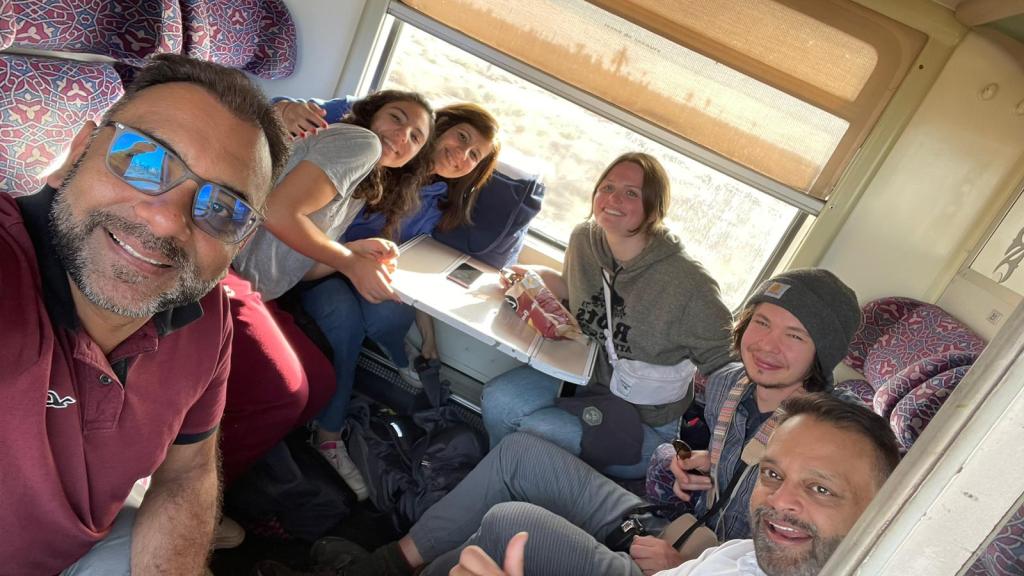
Watching the changing landscapes pass by was really enjoyable. However, the best part of the journey was the people we met on the way. From Casablanca to Marrakech, we were seated in a cabin with 2 local Moroccan women and 2 men from London. At some point, a conversation started, and didn’t end until we arrived in Marrakech. We talked about culture, politics, our lives, and so much more. It was really special to have this connection, even if it was brief. At the end of the journey, we exchanged numbers and took a selfie, all acknowledging how unusual it is to find connection and deep conversation among a group of complete strangers. Even if you don’t make friends with strangers on your journey, trains are still one of the best ways to travel in Morocco. Tickets can be bought online through ONCF Voyages, liked here.
Grand Taxis
Grand taxis are a great option if you’re traveling between cities without regular bus connections. These are shared taxis, typically split between 6 people, plus a driver. Each person purchases a seat, and the taxi leaves once full. They can get crowded, as the cars used are not often much bigger than regular taxis. If you want some extra space, you can purchase additional seats, which will also cause the taxi to leave sooner. Grand taxis can usually be found lined up outside bus/train stations, and are a different color than the city’s official taxi color. Make sure to only take official taxis, indicated by an official mark on the door. You may also want to haggle for a better price, to avoid getting overcharged.
Petit Taxis
Taxis are the priciest of transport methods in Morocco, though sometimes necessary. In some cities, taxis are the only way to get from the airport to the city center. When taking a taxi, it’s very important that you only take official taxis licensed by the city. Usually this is indicated by the color of the car (Fes = red, Marrakech = yellow, Chefcahouen = blue, etc.). They also usually have a logo indicating they’re official. Unofficial taxi drivers will rip you off, so if you find yourself walking toward an unmarked car, you should find another driver. Liam and I made this mistake once in Agadir, and wound up paying more than we were promised (the driver “didn’t have change”) and were dropped off pretty far from where we said we wanted to go.
When taking taxis, you will also want to haggle with the drivers. It’s important that you always settle on a price before getting in the car, to avoid getting overcharged on arrival. All of the taxis are equipped with meters, though most drivers will tell you they don’t have them. You can try to ask them to use the meter, though I was never successful in doing so. Only once, while in Fes, did a driver use a meter without being asked, and it was our cheapest taxi ride of the trip. Most of the bus and train stations are far from the medinas, so you usually will need to take a taxi, or be prepared to walk a few kilometers. In Fes and Marrakech, a good benchmark price is 50 dirhams. Try to get your driver down to that price, and if they don’t agree, be prepared to walk away – there’s always more drivers!
Final Thoughts
If you’re planning a backpacking trip through Morocco, I hope these tips are helpful! The biggest piece of advice I have is to let go of your expectations and just go with the flow. In Morocco, you should never be in a hurry, and if you are, be prepared to be disappointed. Life here is much more relaxed, and its best just to lean into it. Plan your travel if it makes you feel more secure, but also be prepared for the unexpected. And if you do show up at the bus station with nothing prepared, and I promise you’ll still get to where you need to go.
 JEB Travels